Phonetics and phonology as the basis for the study of vocal language.
ABOUT THE PHONETIC
When we talk about phonetics, we refer to one of the most important branches of linguistics related to communication. Phonetics focuses on the study of the perception, transmission, and pronunciation of the different sounds that make up speech. It is mainly concerned with the physical properties of human speech sounds, and how these are produced according to the rules of a language to give meaning to oral expression.
But what does phonetics study?
- How sounds are formed (articulatory features).
- How sounds travel (acoustic properties).
How we hear and interpret sounds (auditory perception
:max_bytes(150000):strip_icc()/Getty_phonetics-475158545-56afa4bc5f9b58b7d01b6cf0.jpg) |
Image taken from: https://www.thoughtco.com/thmb/Laa-OqQFWASM3YaojcfuZR4vAIg=/768x0/filters:no_upscale():max_bytes(150000):strip_icc()/Getty_phonetics-475158545-56afa4bc5f9b58b7d01b6cf0.jpg
WHAT ABOUT THE PHONOLOGY?
Phonology is the branch of linguistics that studies
sounds and sound systems. It focuses on the patterns of sound in a specific
language and analyzes how these sounds can interact and change depending on the
context in which they are used.
What does phonology study?
- How sounds are formed (articulatory features).
- How sounds travel (acoustic properties).
-
How we hear and interpret sounds (auditory
perception).

Image taken from: https://media.proprofs.com/images/QM/user_images/2503852/Phonetics-.webp
Differences between phonetics and phonology
Although phonetics and phonology are closely related, they are not the same. Each focuses on different aspects of how language works:
- Phonetics is concerned with how speech sounds are physically produced, transmitted, and perceived.
- Phonology, on the other hand, studies how those sounds function within a particular language, including how phonemes interact, the rules behind sound patterns, and the suprasegmental features like stress and intonation.
In short, phonetics deals with the production of sounds, while phonology analyzes the system behind those sounds in a given language.
PLACES OF ARTICULATION
The place of articulation refers to the specific location in the mouth where a sound is produced. This includes parts such as the tongue, teeth, or lips. These places are essential in articulatory phonetics and are also relevant in phonology, since they help us understand not only how a sound is produced, but also its quality—and in some cases, how it can influence the meaning of words.
Understanding places of articulation allows us to classify and differentiate various consonant sounds, and even vowel sounds in certain contexts.
Main Places of Articulation:
- Bilabial: Both lips
- Labiodental: Lower lip against the upper teeth
- Dental: Tip of the tongue against the base of the upper teeth
- Alveolar: Tip of the tongue against the alveolar ridge (behind the upper teeth)
- Postalveolar: Tip or blade of the tongue against the back of the alveolar ridge
- Palatal: Body of the tongue against the hard palate
- Velar: Back of the tongue against the soft palate (velum)
- Uvular: Back of the tongue against the uvula
- Glottal: Vocal cords
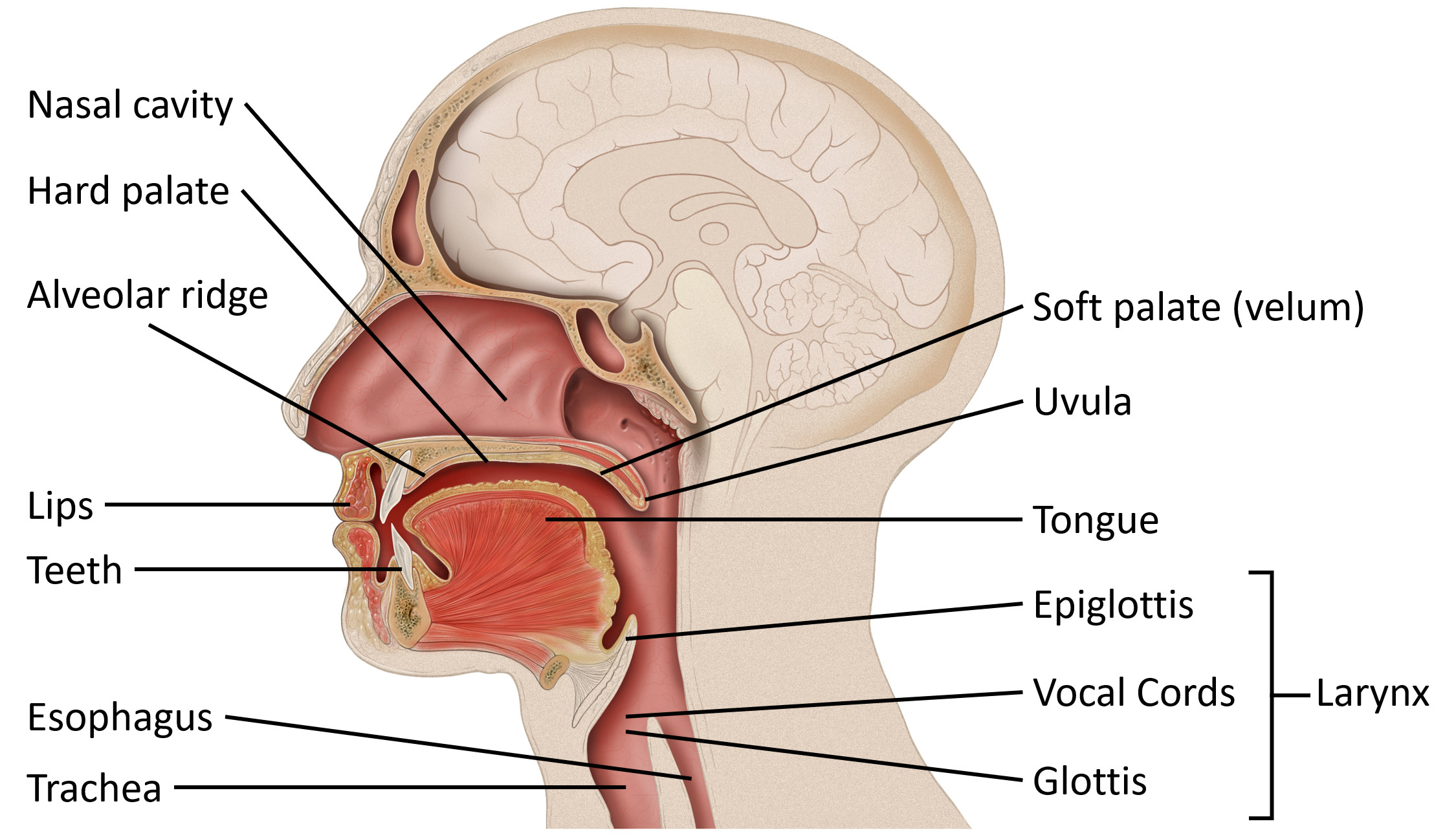
Image taken from:https://opentextbc.ca/psyclanguage/wp-content/uploads/sites/356/2021/02/Parts-of-the-Vocal-Tract-2.png
ARTICULATORS INVOLVED IN SOUND PRODUCTION
Articulators are anatomical structures in the mouth and vocal tract that shape the airflow to produce different speech sounds. These are divided into two types:
Movable (active) articulators:
- Tongue: tip, blade, front, back.
- Lips: upper and lower.
-
Soft palate (velum): moves to block or allow airflow
through the nose.
Fixed (passive) articulators:
- Alveolar ridge: the ridge behind the upper teeth
- Hard palate: the roof of the mouth
- Teeth: involved in dental and labiodental sounds
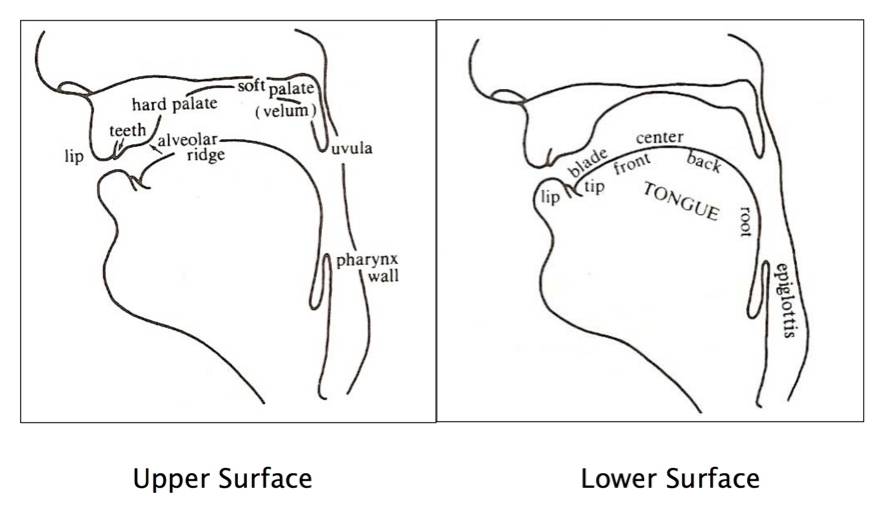
Image taken from:https://www.ling.upenn.edu/courses/Fall_2013/ling520/Articulators1.png
CONTENT WORDS
A content word is a word that carries specific meaning in a sentence. These words hold the main idea or message being communicated. They include nouns, main verbs, adjectives, and adverbs.
Examples:
- Understand (verb)
- Expensive (adjective)
In some cases, other words like negatives (not, never), demonstrative pronouns (this, those), or question words (who, what, where) can also be considered content words, as they contribute meaning to the sentence.
FUNCTION WORDS
Function words are words that connect or support the content words in a sentence. While they do not carry strong meaning on their own, they are essential for grammar and structure. These include auxiliary verbs, prepositions, articles, conjunctions, and pronouns.
Each type of function word has a specific role:
- Auxiliary verbs: help form verb tenses
- Prepositions: show relationships in time or space
- Articles: define nouns as specific or general
- Conjunctions: connect words or ideas
- Pronouns: replace nouns in a sentence
Examples:
- Although (conjunction)
- Do (auxiliary verb)
While content words are emphasized in speech because they carry the meaning, function words are not stressed; they serve to link and organize the message.
FALLING INTONATION
Falling intonation is a common intonation pattern used in different contexts to give or request new information in a conversation, often leaving the topic open for response. It usually occurs in:
- Statements
- Commands
- WH-questions (who, what, where, when, why, how)
It is also used when we say something in a definite, complete, or serious way, or when we want to make something clear.
Examples:
- Where is Sara?
- She studies gastronomy.
RISING INTONATION
Rising intonation describes when the voice goes up at the end of the sentence. It is commonly used in:
- Yes/No questions
- Expressions of doubt or surprise
Examples:
- Did William travel to London?
- It’s getting really cold?
Fall-Rise Intonation
Fall-rise intonation is a combination of falling and rising pitch. It is used at the end of statements when:
- The speaker is uncertain.
- There is more to add.
- The speaker is being polite or cautious.
Example:
I’m not sure I want to visit Florida... (but maybe I’ll enjoy it).
English is not a tonal language, meaning intonation does not change the literal meaning of words or grammar. However, it does affect the feeling or attitude behind what we say.
The pronunciation of a sentence or text as an example:
By understanding both areas, we can gain deeper insight into how language is constructed and the processes behind oral communication and comprehension. This allows us to practice in a more conscious and effective way, especially by identifying the different places of articulation and how they contribute to the production of speech sounds.
References
Mimic Method. (s.f.). Place of articulation. The Mimic Method. Recuperado de https://www.mimicmethod.com/ft101/place-of-articulation/
University of Sheffield. (s.f.). What do phoneticians study? All About Linguistics. Recuperado de https://www.sheffield.ac.uk/linguistics/home/all-about-linguistics/about-website/branches-linguistics/phonetics/what-do-phoneticians-study/articulatory
Salón de Idiomas. (2021, febrero 4). La fonética en inglés. Recuperado de https://salondeidiomas.es/la-fonetica-en-ingles/
Open Textbook BC. (s.f.). The articulatory system. Psychology of Language. Recuperado de https://opentextbc.ca/psyclanguage/chapter/the-articulatory-system/
SomiNotes. (2018, septiembre 13). Phonetic & phonological analysis: Can you describe the basis of phonetics and phonology? Recuperado de https://mysominotes.wordpress.com/2018/09/13/1-1-phonetic-phonological-analysis-can-you-describe-the-basis-of-phonetics-and-phonology/
University of Pennsylvania. (2013). Lecture notes 2: The articulatory system. Ling 520 – Introduction to Linguistics. Recuperado de https://www.ling.upenn.edu/courses/Fall_2013/ling520/LectureNotes2.html
Nordquist, R. (2020, agosto 27). Content and function words. ThoughtCo. Recuperado de https://www.thoughtco.com/content-and-function-words-1211726
The Sound of English. (s.f.). Falling intonation. Recuperado de https://thesoundofenglish.org/falling-intonation/
Cambridge Dictionary. (s.f.). Intonation – British Grammar. Recuperado de https://dictionary.cambridge.org/es/gramatica/gramatica-britanica/intonation

